


What Is Equity in Business: Definition, Types, and How To Calculate

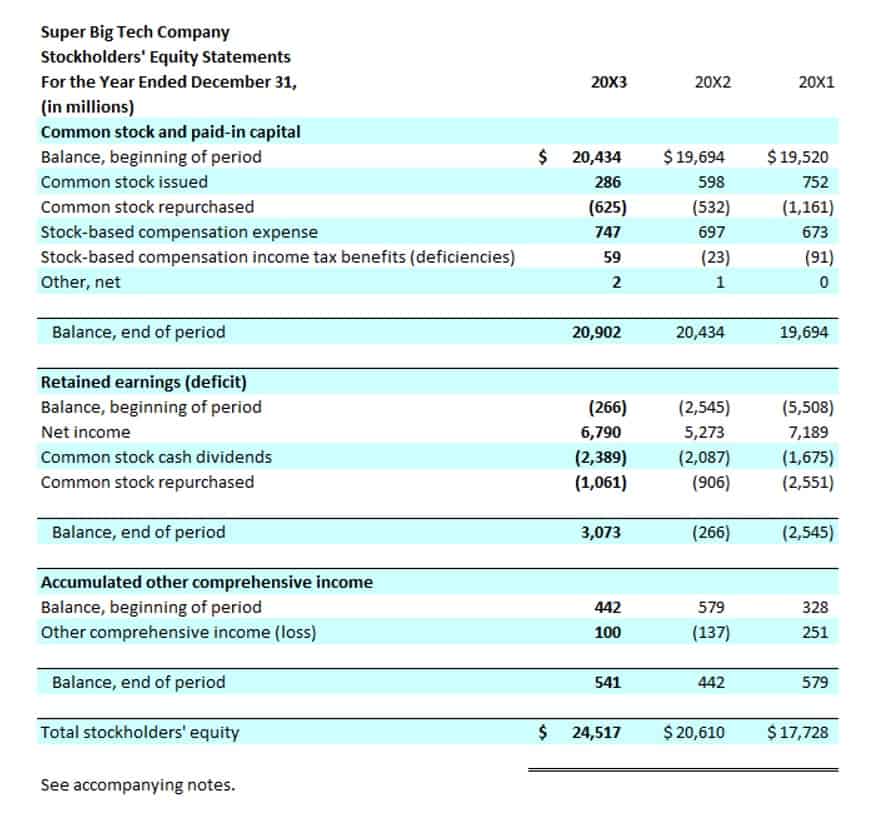
A return on equity that widely changes from one period to the next may also be an indicator of inconsistent use of accounting methods. Successful investors look well beyond today’s stock price or this year’s price movement when they consider whether to buy or sell. If the company ever had to be liquidated, it’s what the shareholders would get.
- At its core, total equity refers to the ownership interest in a company.
- For example, the equity of a company with $1 million in assets and $500,000 in liabilities is $500,000 ($1,000,000 – $500,000).
- This document should include all your company’s assets and liabilities.
- For example, if a company acquires additional assets, such as property or equipment, it may increase its equity position.
- When used alongside metrics like cash flow analysis, profit margins, debt-to-equity ratio, and Return on Investment (ROI), equity helps assess your startup’s overall well-being.
- They may help determine company policies and have a say in who joins the board of directors.
- Business owners can increase equity value by reinvesting profits, which can attract investors and enhance growth opportunities.
How Return on Equity (ROE) Works

Discover the types, eligibility, pros, and cons for your business success. Discover how to fund growth, manage cash flow, and invest in success. Investors consider APIC when weighing the cost of a share today versus its value during a company’s initial public offering (IPO).

Asset Types and Their Impact
The prudent management of equity can empower companies to navigate the complexities of market fluctuations, fund innovative ventures, and secure a competitive edge. It holds the promise of collective success through shared ownership, entwining the fortunes of investors and businesses how to calculate equity in business in a dynamic financial landscape. When a company sells shares, it invites investors to participate in its future success.
How to Calculate Company Equity

Return on equity (ROE) measures how effectively a company uses its equity to generate profits. A higher ROE indicates efficient use of equity in finance to create shareholder value. Calculating equity is a fundamental step in assessing a company’s financial health. Equity represents the net value of a business after accounting for all its liabilities. The calculation itself is Bookkeeping for Consultants simple yet revealing, offering insights into a company’s financial standing and guiding critical decisions. This positive equity suggests that the company has a solid financial foundation.
Potential Conflict
For shareholders, it indicates their stake in the company’s value. Equity can be increased by reinvesting profits or attracting more investors, enhancing growth opportunities. Calculating equity regularly helps businesses maintain their financial health.
- Master the insights that can unleash your potential in this dynamic industry.
- Striking the right balance between equity and debt financing is a strategic choice for companies.
- To calculate equity on a balance sheet, the first step is to identify and quantify the company’s total assets.
- Equity represents the residual claim on assets after satisfying liabilities.
- In the first year, the coffee shop earns $120,000 in gross profits and incurs $70,000 in expenses for a net profit of $50,000.
- This document is intended to convey a business’s «big picture» overview and an in-depth rendering of assets and liabilities.
Another balance sheet line item shows total liabilities, which were $3.4356 billion. Subtracting liabilities from assets shows that shareholders equity was $592.9 million, which indicates that Peloton is a positive equity example. Total equity represents the cornerstone of a company’s financial standing, reflecting the owners’ residual interest in its assets after deducting liabilities. At its core, total equity refers to the ownership interest in a company.

- Expressed as a percentage, it’s computed by dividing the principal balance of your mortgage by your home’s appraised value and multiplying the result by 100.
- The equity equation is important because it provides a clear and concise way to determine the value of a company’s equity.
- Liabilities are debts and obligations that your business owes to outside parties.
- It represents an owner’s claim to whatever remains if a business sold its assets and paid its liabilities.
- This means Home Depot has more liabilities than assets, which is likely a consequence of their aggressive stock buyback strategy.
- Investors and business owners use it to gauge a business’s worth, ability to manage debt, and growth potential.
Sometimes, a venture capitalist will take a seat on the retained earnings balance sheet board of directors for its portfolio companies, ensuring an active role in guiding the company. Venture capitalists look to hit big early on and exit investments within five to seven years. An LBO is one of the most common types of private equity financing and might occur as a company matures.
- InvestingPro offers detailed insights into companies’ Degree of Financial Leverage including sector benchmarks and competitor analysis.
- Owners of common stock generally have voting rights towards board elections, appointments of corporate offers, governing, and policies.
- Knowing where your business stands helps you make better-informed decisions in running and growing your business.
- If all of the company’s assets were liquidated and used to pay off debts, the shareholders’ equity is the amount that would be left over.
- It is an important metric that helps stakeholders understand the financial health and stability of a company.
Return on Equity (ROE) Calculation and What It Means
This means that the balance sheet should always balance, hence the name. If they don’t balance, there may be some problems, including incorrect or misplaced data, inventory or exchange rate errors, or miscalculations. A balance sheet is a financial statement that provides a snapshot of a company’s assets, liabilities, and shareholder equity at a specific point in time. In its 2021 annual report, Home Depot reported ~$72m in total assets, including cash, accounts receivable, and finished goods.
 POLEAS
 REFRIGERACIÓN